

How Often Should You Power Flush Central Heating?
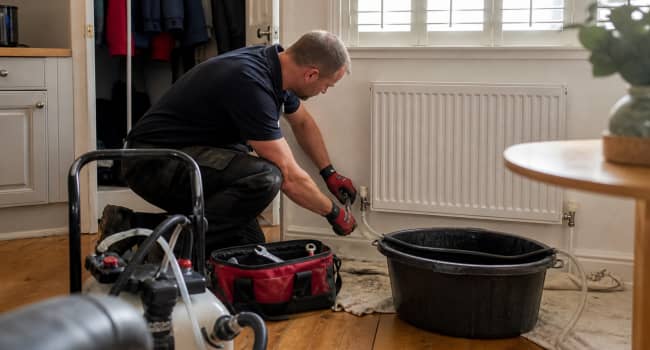
Radiators that stay cold at the bottom, a boiler that rumbles like a kettle, or an installer mentioning a power flush while quoting for a new boiler. Any of these can make you wonder how often you should power flush central heating, and whether it’s something you’re meant to book in on a schedule, like a boiler service.
It’s a fair question, and the answer isn’t the one most people expect. Here we’ll cover how often a power flush really needs doing, which signs to look for, what changes when you’re fitting a new boiler, and how to cut the odds of ever needing a second one.
TL;DR
- A power flush has no fixed interval. It’s done when a system shows signs of sludge, not on a timer.
- Many systems need one only once in their life, often when a new boiler is fitted to an older heating system.
- Cold spots at the bottom of radiators, black water when bleeding and slow heat-up are the main signs.
- An annual inhibitor check and a magnetic filter cut the chance of needing another flush.
- A power flush is a professional job, and any work connecting to the boiler must be done by a Gas Safe registered engineer.
Table of Contents
- How Often Should You Power Flush Central Heating?
- What Signs Show a Central Heating System Needs a Power Flush?
- Should You Power Flush When Fitting a New Boiler?
- How Do Inhibitor and a Magnetic Filter Change How Often You Need a Power Flush?
- Power Flush vs Chemical Flush: Which One Does Your System Need?
- Can You Power Flush Central Heating Yourself?
- Frequently Asked Questions
How Often Should You Power Flush Central Heating?
There is no fixed schedule for a power flush. Power flush central heating when the system shows signs of sludge, or when a new boiler is fitted to an older system. A well-maintained system dosed with inhibitor and fitted with a magnetic filter may never need one.
Here’s why. Sludge is rust and debris that comes off the inside of steel radiators and pipework. How fast it builds depends on the age of the system, the water quality, whether inhibitor was ever added, and how often the system has been opened up. A boiler service happens every year whether anything is wrong or not. A power flush is a fix for a condition, so you do it when the condition is there.
Flushing “every few years, just in case” gives you nothing on a clean system. What is routine is a yearly look for sludge signs, plus the inhibitor and filter checks covered below.
| Situation | Power flush needed? | Why |
| Cold spots, black water, noisy boiler or slow heat-up | Likely yes | These are the usual signs of sludge restricting flow. |
| New boiler going onto an older system | Often yes | Old sludge can damage the new boiler, and the warranty may require a clean system. |
| Healthy system with inhibitor and a filter | No | Little sludge is forming, so there’s nothing to flush out. |
What Signs Show a Central Heating System Needs a Power Flush?
The main signs are radiators that are cold at the bottom but hot at the top, black or brown water when you bleed a radiator, a noisy or kettling boiler, slow heat-up, and radiators that need bleeding again and again. Two or three of these together point strongly to central heating sludge.
- Cold spots at the bottom of radiators: sludge is heavy, so it settles low down and blocks hot water from reaching the base.
- Black or brown water when bleeding: the water is carrying rust particles (magnetite) from corroding steel.
- Noisy boiler or kettling: sludge and scale on the heat exchanger make water boil in pockets, which sounds like a kettle.
- Slow heat-up: the radiators take far longer than they used to, because flow is restricted.
- Radiators needing frequent bleeding: corrosion produces hydrogen gas, which collects as air-like pockets at the top.
- Pump or valves failing repeatedly: sludge wears moving parts and jams radiator valves.
Sludge water is hard to mistake once you’ve seen it. It comes out of the bleed valve looking like thin ink or stewed tea, and it often has a musty, rusty smell.
Pro Tip: When you bleed a radiator, hold a clear cup or a white cloth under the valve so you can see the true colour of the water.
Some of these signs have other causes, so don’t book a flush on one symptom alone. Radiator cold spots can also come from trapped air or a stuck valve. Meanwhile, boiler kettling can come from limescale as well as sludge. An engineer can check the water and the flow before you commit to anything.
Should You Power Flush When Fitting a New Boiler?
Often yes, if the old system is more than a few years old or shows sludge. Old sludge can clog a new boiler’s heat exchanger, and many manufacturers require a clean, inhibited system to keep the warranty valid. Always check the boiler manual for the exact condition.
A new boiler is the one moment when a power flush is commonly expected. A boiler that has reached the end of its life is the usual point the question comes up, and when to replace a boiler usually lands at 10–15 years. By then an older system with steel radiators and no inhibitor has often built up a lot of sludge, and a brand-new boiler shouldn’t be connected to it as it is.
- Flush may not be needed: the system is new, or it was recently cleaned and dosed with inhibitor, and the water runs clear.
- Flush first: the radiators have cold spots, the water is black or brown, or nobody can say when the system was last treated.
How Do Inhibitor and a Magnetic Filter Change How Often You Need a Power Flush?
Inhibitor slows corrosion and a magnetic filter catches the particles that do form, so together they greatly reduce sludge build-up and the need for repeat flushes. Test the inhibitor level once a year, and top it up after any drain-down or radiator removal.
Most people get this backwards. They ask how often to flush, when the better question is how to stop the sludge coming back. Inhibitor is a liquid added to the system water that coats the metal and stops it rusting. It doesn’t last forever, and some is lost every time water leaves the system. A magnetic filter sits on the pipe near the boiler and traps the rust that still gets through, so it never reaches the heat exchanger or pump. Engineers often open a full filter and find a thick black paste clinging to the magnet, which is exactly the stuff you don’t want circulating.
Neither is a one-off job. The filter fills up and needs cleaning, and the inhibitor level drifts down over time.
Yearly routine:
- Check for the signs above: cold spots, noise, slow heat-up, dark water when you bleed a radiator.
- Ask your engineer to test the inhibitor level, and top it up if it’s low.
- Have the magnetic filter cleaned at the annual service.
Fitting that into your annual boiler maintenance costs very little extra. If the system is ever drained, the inhibitor has to be replaced too, and our guide on how to drain a central heating system covers what that involves. A drain-down doesn’t automatically mean a power flush is needed, but it does mean fresh inhibitor.
Power Flush vs Chemical Flush: Which One Does Your System Need?
Choose the treatment by how much sludge is in the system: a chemical flush for mild sludge, a power flush for heavy sludge, and a filter with inhibitor alone for a healthy system.
| Treatment | Best for | Limits |
| Chemical flush | Mild sludge; quicker, no pump unit | Less effective on heavy, packed-in sludge |
| Power flush | Heavy sludge; older systems | Takes longer and is more involved; not needed on a clean system |
| Filter and inhibitor only | Maintenance on healthy systems | Won’t remove sludge that’s already built up |
A professional power flushing service connects a pump unit to the system, circulates cleaning chemicals at high flow to loosen and remove sludge, then tests and refills the system with fresh inhibitor. An engineer will usually pick a chemical flush for mild cases and a power flush where radiators are badly blocked.
Flushing more often than the system needs wastes money and gains nothing. On old, corroded pipework, the extra flow and pressure can also expose weak joints, which then start to leak.
Can You Power Flush Central Heating Yourself?
No. A power flush needs a specialist pump unit, correct connection to the pipework and safe disposal of the sludge, and any work connecting to the boiler must be done by a Gas Safe registered engineer.
Getting hold of the kit is easy enough. Connecting it, controlling the flow and judging what the system can take is where it goes wrong, and you can damage the boiler, flood a room or leave the system worse than you found it. What you can do yourself is spot the signs, bleed radiators and ask your engineer about inhibitor at the next visit.
When you book someone, check they’re on the Gas Safe Register and ask to see their ID card before they start. If you’re not sure where to start, see how to find a trusty boiler engineer.
Frequently Asked Questions
How long does a power flush take?
A power flush on a standard house typically takes about one day. Larger houses, or systems with a lot of heavy sludge, can take longer, because each radiator is flushed in turn until the water runs clear. The engineer will usually refill the system with fresh inhibitor at the end, so plan for the heating to be off while the work is done.
How long do the results of a power flush last?
The results can last for years, as long as the system is refilled with inhibitor, the inhibitor is tested each year and a magnetic filter is fitted. Without those, rust keeps forming and sludge can start building up again, so the system may need cleaning sooner than you would like.
Does a power flush improve boiler efficiency?
It can. Removing sludge restores water flow and heat transfer, so radiators heat up faster and the boiler doesn’t have to work as hard to reach the temperature you want. The gain depends on how bad the sludge was. A system that was already clean won’t change much, which is another reason to flush only when there are signs.
Is a power flush needed for underfloor heating or a new-build?
Rarely for a new system, as new-builds are normally flushed and treated at commissioning. Underfloor heating uses different cleaning methods, so a standard radiator power flush is not the right approach. If you have underfloor heating, or you’re unsure how your new-build was treated, get professional advice before anything is connected.
Conclusion
A power flush is a response to a condition, not a date in the diary. Watch for cold spots, black water and a noisy boiler, and flush when the system tells you it needs it. The one time it’s commonly expected is when a new boiler goes onto an older system.
The best way to avoid needing a second flush is the dull routine: a magnetic filter, inhibitor topped up and tested each year, and a quick check at the annual service. Leave the heavy work to a Gas Safe registered engineer, and save the flush for when it’s actually needed.
How Often Should You Power Flush Central Heating?
Need help? Hire the London Property Service experts today by giving us a call on 020 3078 5920.