

How Does Underfloor Heating Work? Wet and Electric Systems Explained
You’re planning a renovation, an extension or a new bathroom, and the quote or showroom brochure mentions underfloor heating. It sounds lovely, but there’s no radiator in sight, so how does underfloor heating work, and how can a floor heat a whole room? It’s a fair question, especially when you’re also thinking about the cost, the disruption and whether it will suit your boiler.
This guide explains the mechanism in plain English. We’ll cover wet and electric systems, the parts that make them run (the manifold, the mixing valve and the thermostats), how a wet system connects to your boiler or heat pump, and the pros and cons.
TL;DR
- Underfloor heating warms the floor, and the floor then radiates heat evenly up into the room, replacing wall radiators.
- Wet systems circulate warm water, typically 35–50°C, through pipes from a boiler or heat pump.
- Electric systems pass current through heating cables or mats, which suits single rooms such as bathrooms.
- A manifold splits the water into room loops, and a mixing valve cuts hot boiler water to a floor-safe temperature.
- Thermostats switch each zone on and off, and the floor warms slowly, so a steady schedule works best.
Table of Contents
- How Does Underfloor Heating Work?
- Wet vs Electric Underfloor Heating: What Is the Difference?
- How Does Wet Underfloor Heating Work?
- How Does Underfloor Heating Connect to a Boiler?
- What Does the Underfloor Heating Manifold Do?
- How Does the Underfloor Heating Mixing Valve Work?
- How Does Electric Underfloor Heating Work?
- How Do Underfloor Heating Thermostats Work?
- Does Underfloor Heating Work Under Tiles and Other Floor Coverings?
- How Long Does Underfloor Heating Take to Warm Up?
- What Are the Downsides and Common Problems With Underfloor Heating?
- Is Underfloor Heating Cheaper to Run Than Radiators?
- Frequently Asked Questions
How Does Underfloor Heating Work?
Underfloor heating works by warming the whole floor with hot-water pipes or electric cables. The warm floor gives off radiant heat that rises and heats the room evenly, at a much lower surface temperature than a radiator.
A radiator heats the air next to it, and that warm air rises and circulates around the room. That’s convection. Underfloor heating works mostly by radiation: the floor surface, typically around 24–29°C, sends heat straight up to you, your furniture and the walls. A wet system does this with water at roughly 35–50°C, where a radiator system usually needs about 60–75°C.
Because the heat comes from the whole floor area, there are no hot spots near a radiator and far fewer cold corners across the room. A lower flow temperature helps your boiler too, because a boiler that runs cooler wastes less energy, and that’s a big part of boiler efficiency.
- Heat is spread across the whole floor, so the room warms evenly from the bottom up.
- Warmth is felt at foot level, where you notice it most.
- The system runs at a lower temperature than radiators, which suits condensing boilers and heat pumps.
- There are no radiators to take up wall space.
Wet vs Electric Underfloor Heating: What Is the Difference?
Wet underfloor heating uses hot-water pipes connected to a boiler or heat pump and suits whole-house or large-area use. Electric underfloor heating uses cables or mats and suits single rooms and retrofits, because it’s thin and simple to fit.
| Feature | Wet (water) | Electric |
| Heat source | Boiler or heat pump | Mains electricity |
| Best for | Whole house, extensions, large rooms | Single rooms such as bathrooms and kitchens |
| Install effort | Higher: pipework, manifold, mixing valve | Lower: cables or mats and a thermostat |
| Running cost | Lower, especially with a condensing boiler or heat pump | Higher per hour of use |
| Floor height added | Usually more, from low-profile systems to a full screed | Very little, often just a few millimetres |
| Retrofit ease | Harder, unless you’re already lifting floors | Easier, especially under new tiles |
Choose wet if you’re heating a whole floor, an extension or a new build, where the lower running cost helps offset the larger installation. Choose electric if you want to warm one small room, such as a bathroom, without touching the main heating system.
How Does Wet Underfloor Heating Work?
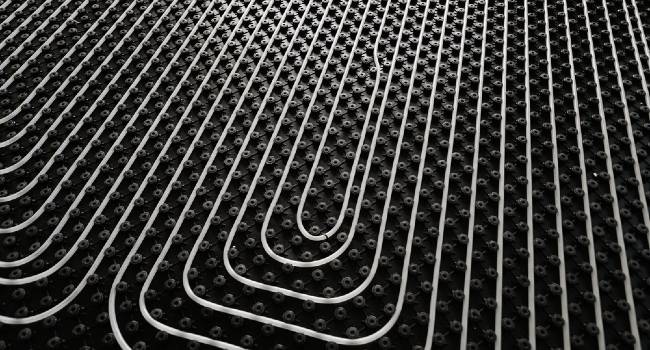
Wet underfloor heating pumps warm water through plastic pipes laid in loops over insulation, either set into screed (a layer of cement-based mix) or held in spreader plates. The water gives up its heat to the floor, and the floor radiates it into the room.
Each loop has a flow pipe that carries warm water out and a return pipe that brings the cooler water back to be reheated by your boiler or heat pump. The closer the pipes are spaced, the more heat the floor gives off, so installers set the spacing to match the room’s heat loss. The water is only warm, typically 35–50°C, because the whole floor is doing the work.
Screed systems
In a screed system, the pipes are clipped onto insulation and then buried in a layer of liquid screed or sand and cement. The screed soaks up heat and passes it to the floor covering above. It gives very even heat and works well in new builds and extensions, but it adds floor height and takes time to dry and heat up gradually.
Overlay and floorboard systems
If you’re adding underfloor heating to an existing house, you don’t have to dig up the floor. Low-profile overlay panels sit on top of the existing floor, and spreader plate systems hold pipes between joists, under the floorboards. Metal plates spread the heat across the floor. These warm up faster than screed because there’s less material to heat first.
How Does Underfloor Heating Connect to a Boiler?
Underfloor heating connects to a boiler through flow and return pipes that run to a manifold, with a mixing valve or blending set reducing the boiler’s hotter water to a floor-safe temperature. The boiler still heats the water, and the manifold shares it out to each room.
A boiler often sends water out at 60–80°C, but a floor circuit needs about 35–50°C. Water at boiler temperature would overheat the floor, damage wood or vinyl and make the surface uncomfortable to stand on. So the mixing valve blends hot flow water with cooler return water, and a small pump pushes that blended water around the floor loops.
The lower floor temperature is a bonus for your boiler. A condensing boiler is most efficient when the water returning to it is cool enough, below about 55°C, for it to condense the flue gases and recover extra heat. Underfloor heating returns cool water, so the boiler can stay in condensing mode. Heat pumps work best at low flow temperatures too, so underfloor heating suits them even better.
You can run underfloor heating alongside radiators on the same boiler, and each part of the system works at its own temperature. The radiators take the hotter water directly, and the floor circuit takes it through the mixing valve. Any work inside the boiler, on gas pipework or on the flue must be done by a Gas Safe registered engineer.
These are the parts that link the boiler to the floor:
- Flow and return pipes carrying water between the boiler and the manifold.
- A mixing valve or blending set that cuts the water to a floor-safe temperature.
- A circulation pump that pushes the blended water around the loops.
- Room thermostats that tell each zone when to call for heat.
What Does the Underfloor Heating Manifold Do?
The manifold is the central distribution unit. It splits the water into separate loops, one per room or zone, and lets each loop be balanced and switched on or off on its own.
The manifold usually sits in a cupboard or utility space. Warm water arrives at one bar and is shared across the loops, then returns through a second bar. Without a manifold, a single long pipe would be hot at the start and cold at the end, and you couldn’t heat one room without heating them all.
- Flow and return bars: carry warm water out to the loops and cooler water back.
- Flow meters: show how much water moves through each loop, so you can balance them.
- Actuators: small valves on each loop that open and close when the room thermostat calls for heat.
- Air vents: let trapped air escape so water can circulate freely.
- Isolation valves: let an engineer shut off a single loop for repair.
How Does the Underfloor Heating Mixing Valve Work?
The mixing valve blends hot flow water with cooler return water to hold the floor circuit at a fixed temperature. This protects your floor covering and keeps the surface safe to stand on.
There are two common setups. A thermostatic mixing valve senses the temperature of the blended water and adjusts the mix on its own. A pump-and-blend set does the same job and also includes the pump that circulates water around the floor loops. Both have an adjustable setpoint, which an engineer sets to suit your floor.
That setpoint matters. The maximum floor surface temperature for wood is typically 27°C, and other coverings have their own limits, so the valve must be set within the floor manufacturer’s guidance. If a mixing valve fails, the floor can run too hot, which is dangerous for the floor covering, or too cold, which leaves you with no heat. A floor that suddenly feels much hotter than normal is a classic sign of a failed valve, and it’s a job for a heating engineer.
How Does Electric Underfloor Heating Work?
Electric underfloor heating passes current through heating cables or a mat fixed under the floor covering. The cables resist the current, so they warm up and heat the floor, and a thermostat with a floor sensor controls the temperature.
Electric underfloor heating is popular in bathrooms, kitchens and conservatories because it’s thin, often just a few millimetres, so it barely raises the floor level. It’s usually fitted under tiles, and fitting insulation boards beneath it makes the floor warm up faster and stops heat escaping downwards. Electric systems have no pipes, pumps or manifold, and they don’t need a boiler.
- Loose cable: a cable laid in a pattern to suit awkward shapes and larger areas.
- Heating mat: cable pre-fixed to a mesh mat that you roll out under tiles, the quickest to fit.
- Foil or film: a thin heating element for fitting under floating floors such as laminate.
Electrical work in a home must meet Part P of the Building Regulations, and wiring in a bathroom must follow the Wiring Regulations, so the connection and testing should be done by a qualified electrician.
How Do Underfloor Heating Thermostats Work?
An underfloor heating thermostat measures the air or floor temperature and signals the manifold actuators or the heating element to switch on or off, holding the room at your set temperature.
On a wet system, each room’s thermostat tells the actuator on that room’s loop to open or close, so rooms heat independently. On an electric system, the thermostat switches the power to the cable or mat. Many are programmable, so you can set different times and temperatures for each zone, and smart versions let you control them from your phone. If you’re comparing controls, our guide to choosing a smart heating thermostat covers what to look for.
| Sensor type | What it measures | Best for |
| Room (air) sensor | Air temperature in the room | Living spaces, where comfort matters most |
| Floor probe | Temperature of the floor itself | Bathrooms and tiled floors, and protecting wood |
| Combined sensor | Air and floor, with a floor-limit cut-out | Timber or other sensitive floor coverings |
Does Underfloor Heating Work Under Tiles and Other Floor Coverings?
Underfloor heating works best under tile, stone and polished screed because they conduct heat well. It can also work under wood, vinyl and carpet, as long as the covering’s thermal resistance and maximum temperature are within the system’s limits.
Under tiles, the heat passes through the adhesive and the tile itself, then spreads across the whole surface. The more a covering insulates, the harder the floor has to work to push heat through it. Check the manufacturer’s guidance for both the floor and the heating system before you buy. For carpet, choose a low tog rating (a measure of how well it insulates) for the carpet and underlay together.
| Floor type | Suitability | Key condition |
| Tile and stone | Excellent | Use a flexible adhesive rated for underfloor heating |
| Engineered wood | Good | Keep the surface at or below about 27°C |
| Solid wood | Limited | Can shrink and gap; follow the maker’s advice closely |
| Vinyl and laminate | Good | Check the maximum temperature rating |
| Carpet | Possible | Use a low-tog carpet and underlay combined |
How Long Does Underfloor Heating Take to Warm Up?
Underfloor heating warms slowly because the floor has to heat up before it heats the room. Screed systems can take several hours to reach temperature, while thin electric mats and low-profile wet systems warm faster.
A deep screed holds a lot of heat, which is why the floor stays warm for a while after the heating switches off, but it also means the system reacts slowly. That’s why a steady schedule beats stop-start use: a floor that’s let drop a few degrees is quick to bring back, while a fully cold one isn’t.
There’s one more practical point for new builds and extensions. A fresh screed must be heated up gradually after it’s laid, following the screed and heating manufacturer’s guidance, before any floor covering goes down. Skipping this and turning the heat up fast can crack the screed.
- Set a longer, lower-temperature schedule rather than short, hot bursts.
- Use a setback temperature a few degrees lower overnight instead of switching off.
- Start the heating earlier in the morning, as the floor needs time to respond.
- Never rush the first heat-up of a new screed.
What Are the Downsides and Common Problems With Underfloor Heating?
The main downsides are slow response, higher installation cost and added floor height. The common faults are airlocks, unbalanced loops, a failed mixing valve or actuator, a pump fault and thermostat faults.
Each problem below comes with its cause and what you can safely do:
- Slow response: the floor takes hours to heat up. Use a steady schedule rather than expecting instant heat.
- Floor build-up height: screed and boards raise the floor, which can affect doors and stairs. Low-profile systems keep this to a minimum.
- Installation cost: wet systems cost more to fit than radiators, especially in an existing house.
- Airlocks: trapped air in a loop stops water flowing, so that loop stays cold.
- Uneven heating from unbalanced loops: if one loop gets more flow than the others, some rooms run warm and others cool. The flow meters on the manifold show whether each loop is getting its share.
- Failed mixing valve or actuator: a floor that’s too hot, too cold, or won’t switch on or off points to one of these parts.
- Circulation pump fault: if the pump isn’t running, no warm water reaches any loop and the whole floor stays cold.
- Thermostat faults: a dead display, flat batteries or a wrong setting is often the cause.
One diagnosis is worth remembering. If a single loop stays cold while the rest of the floor is warm, the cause is usually balancing or an airlock in that loop, not a boiler fault. You can check the thermostat settings and batteries, confirm the pump is running, and look at the loop’s flow meter at the manifold. For anything involving the pump, the mixing valve or gas work, call an engineer. A specialist underfloor heating installation and repair service covers system design, pipework, manifold and mixing valve setup, balancing and fault-finding.
Pro Tip: Take a photo of your manifold flow meters when the system is working well. If a room goes cold later, you can compare the readings and spot the loop that has changed.
Is Underfloor Heating Cheaper to Run Than Radiators?
Wet underfloor heating on a low flow temperature is usually efficient to run, especially with a heat pump or condensing boiler. Electric underfloor heating is generally more expensive to run than a gas-fed wet system.
Whether it’s cheaper to leave underfloor heating on all day depends on your insulation and system type. In a well-insulated home with a heavy screed floor, a steady schedule with a few degrees of setback usually beats stop-start use. A thin electric mat in a bathroom is different: a short timed burst before you need it costs less than leaving it on. The table below spells out the conditions.
| Situation | Likely running cost |
| Well-insulated home, wet system, condensing boiler or heat pump | Efficient, and can be lower than radiators |
| Electric mat in one bathroom, used for short periods | Small, because the area and run time are small |
| Electric system heating a large room for many hours | High, as electricity costs more per unit than gas |
| Poorly insulated room, system left on constantly | Higher, because heat escapes as fast as it’s made |
Good insulation under the floor makes the biggest difference in every case, because it sends heat up into the room instead of down into the ground. For wider savings, there are simple ways to cut your energy bills that work alongside any heating system.
Frequently Asked Questions
Can you install underfloor heating yourself?
You can lay some electric mats and low-profile wet panels yourself if you’re a confident DIYer, but not the whole job. The electrical connection and testing needs a qualified electrician, and joining a wet system to your boiler or heat pump needs a heating engineer. Any work inside the boiler, or on gas pipework or flues, must be done by a Gas Safe registered engineer.
Do you need to turn underfloor heating off in summer?
Yes, if you don’t want any heat. On a wet system, turn the room thermostats down or set the heating programmer to off, so the actuators stay closed and no hot water goes to the floor. On an electric system, turn the thermostat off, or switch it off at its isolator if you won’t use it for months. Your hot water usually keeps working as normal.
Is underfloor heating suitable for every room?
Most rooms are suitable, including bathrooms, kitchens and living rooms. Don’t lay electric heating under fixed units or wardrobes, because the heat can’t escape and the cable can overheat. Thick rugs, deep carpets and furniture that sits flat on the floor cut the heat reaching the room. Solid wood floors need careful temperature limits, so check with the floor’s manufacturer first.
How do you balance underfloor heating loops?
Each loop on the manifold has a flow meter that shows how much water it receives and a valve that adjusts it. Balancing means setting every loop to the flow its design calls for, so all the rooms heat evenly. You can safely check the readings, but a heating engineer should do the final balance, because the right flow depends on loop length, pipe spacing and the room’s heat loss.
Conclusion
Underfloor heating works by turning the whole floor into a gentle, low-temperature radiator. In a wet system, the manifold shares warm water between rooms, the mixing valve keeps it at a floor-safe temperature, and the thermostats decide when each zone heats. An electric system does the same job with cables or mats and no pipework.
Choose wet for whole-home heating, where it runs efficiently alongside a condensing boiler or heat pump. Choose electric for a small single-room job such as a bathroom. Either way, a slow, steady schedule gets the best results.
How Does Underfloor Heating Work? Wet and Electric Systems Explained
Need help? Hire the London Property Service experts today by giving us a call on 020 3078 5920.