

How to Bleed a Radiator Without a Key: Safe Alternatives for UK Homes
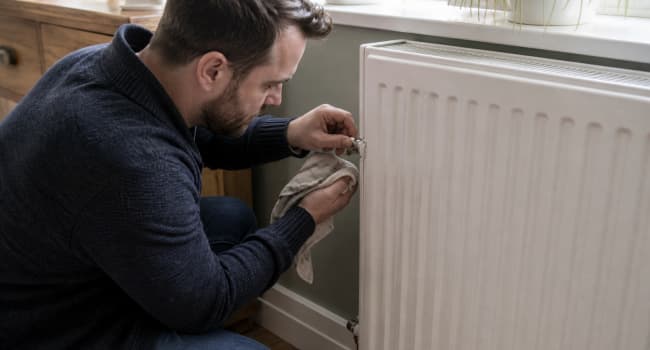
The top of your radiator is cold, the bottom is warm, and there’s a gurgling noise every time the heating comes on. The room still won’t warm up, and the bleed key you bought years ago has vanished into a drawer you’ll never find. Now you need to know how to bleed a radiator without a key.
It’s a common problem, and plenty of homeowners get stuck at exactly this point. This guide covers which household tools work, how to match them to your valve, the full process from start to finish, and what to check afterwards so the radiator stays warm.
We’ll also cover the risks of using improvised tools, because a rounded or fully removed valve turns a quick job into a wet carpet.
TL;DR
- You can bleed a radiator without a key only if the valve has a slot or socket your tool fits, most often a flat-head screwdriver.
- Turn the heating off and let the radiator cool before bleeding. Never bleed with the heating on.
- Turn the valve a quarter turn anticlockwise, let the air hiss out, and close it finger-tight as soon as a steady stream of water appears.
- Bleed downstairs radiators first, then upstairs, starting with the one nearest the boiler.
- Check the boiler pressure before and after bleeding: it should read about 1–1.5 bar when the system is cold.
- Never fully unscrew the bleed valve, and stop if the valve is rounded or stuck.
Table of Contents
- How Do You Bleed a Radiator Without a Key?
- What Can You Use Instead of a Radiator Bleed Key?
- How to Bleed a Radiator Without a Key, Step by Step
- Can You Bleed a Radiator While the Heating Is On?
- What Order Should You Bleed Radiators In?
- How Do You Bleed a Towel Radiator or an Old Radiator Without a Key?
- When Do You Stop Bleeding a Radiator?
- Why Is My Radiator Still Cold After Bleeding?
- Why Do Radiators Need Bleeding and How Often?
- Frequently Asked Questions
How Do You Bleed a Radiator Without a Key?
You can bleed a radiator without a key by using a flat-head screwdriver on a slotted valve, or a small adjustable spanner on a square valve. Turn the valve a quarter turn anticlockwise with the heating off, because the valve only needs to open slightly to let the trapped air escape.
The bleed valve is a small screw in the top corner of the radiator, at the opposite end from the thermostatic valve. A bleed key is just a handy shape that fits the square spindle on older valves. Many modern valves have a plain slot instead, so a screwdriver does the same job. If your valve has no slot, square spindle, socket or hand-turn knob that your tools fit, a bleed key is the answer.
What you’ll need:
- A tool that fits your valve (see the table below)
- An old cloth or towel to catch drips
- A small container or cup to hold under the valve
What Can You Use Instead of a Radiator Bleed Key?
Match the tool to your valve: a flat-head screwdriver or coin for slotted valves, a small adjustable spanner for square ones, a hex key for hex sockets, and your fingers for thumb-screw valves. The bleed valve is the small screw at the top corner of the radiator that lets trapped air out.
| Valve type | What it looks like | Tool that works | Notes |
| Slotted screw head | A flat groove across the centre of a round screw | Flat-head screwdriver, or a coin on a wide slot | Most common on modern valves. Use a screwdriver that fits the slot snugly. |
| Square spindle | A small square peg sticking out of the valve | Small adjustable spanner, or pliers gripped lightly | Easy to round off the corners. Grip gently and turn slowly. |
| Hex (Allen) socket | A six-sided hole in the centre of the valve | Matching hex key | Check the size. A key that’s too small will slip and damage the socket. |
| Integrated thumb-screw (key-free) | A small knurled knob or wing on the valve | Turn by hand | Found on some newer radiators and towel rails. No tool needed. |
A bleed key costs only a few pounds at any DIY store. If nothing in your toolbox fits the valve, buy one rather than force it. Pliers and spanners can round off the spindle, and a damaged spindle is hard to turn again. If the valve is already chewed up or won’t close properly, you may need to change the radiator valve.
How to Bleed a Radiator Without a Key, Step by Step
Bleeding radiators takes around 15 minutes, depending on how many you need to do, and it’s a safe job for any homeowner. Follow the steps in order, and keep the cloth and container close.
Bleed a radiator without a bleed key using a household tool that fits the valve, with the heating off.
Find the radiators that need bleeding
With the heating on, feel each radiator. A cold patch at the top with a warm bottom, or a gurgling noise, means trapped air. Make a note of which radiators need bleeding.
Turn the heating off and let the radiators cool
Switch off your central heating and wait at least 30 minutes, until the radiators are cold or only lukewarm. This stops the pump pushing more air around the system and avoids scalding water. Note the boiler pressure gauge reading before you start.
Put a cloth and container under the valve
Lay a towel on the floor under the bleed valve and hold a small container just below it. A little water usually comes out once the air has gone.
Fit your tool and turn a quarter turn anticlockwise
Fit a flat-head screwdriver, spanner or hex key that matches the valve. Turn it slowly anticlockwise by about a quarter turn, no more.
Listen for the hiss
A hissing sound means air is escaping. Keep the valve open and hold the cloth against it until the hissing stops.
Close the valve when water appears
As soon as a steady stream of water replaces the air, turn the valve clockwise until it is closed. Tighten it finger-tight only.
Wipe the valve and check for drips
Dry the valve and the area underneath with the cloth. Check that no water is dripping from the valve once it is closed.
Turn the heating back on and check the pressure
Switch the heating back on and feel the radiator from top to bottom, which should now heat evenly. Check the boiler pressure gauge again once the system has cooled: it should read about 1–1.5 bar. If it has dropped below 1 bar, top it up with the filling loop as your boiler manual describes.
Pro Tip: Never undo the bleed valve completely. A quarter turn is usually enough to release the air, and unscrewing it any further risks water spraying out fast from the open valve.
Can You Bleed a Radiator While the Heating Is On?
No, you should turn the heating off and let your radiators cool before bleeding. The pump keeps circulating water while the heating is on, which can pull more air into the system, and the water inside a hot radiator can scald you.
If the heating has been off for at least 30 minutes and the radiator is only lukewarm, it’s safe to bleed. If it’s still hot to touch, wait longer. A fully cooled radiator is the safest to work on.
What Order Should You Bleed Radiators In?
Start with the radiator nearest the boiler on the ground floor, work through to the one furthest away, then repeat the same order upstairs. Air rises through the heating system and collects at the highest points, so upstairs radiators come last.
- Bleed the ground floor radiator closest to the boiler first.
- Move through the rest of the ground floor, ending with the furthest radiator from the boiler.
- Go upstairs and repeat the same order, nearest to furthest.
- Check the boiler pressure gauge and top it up if needed.
If the pressure has dropped, our guide on how to repressurise a boiler walks you through the filling loop, the small flexible pipe that tops up your system with water.
How Do You Bleed a Towel Radiator or an Old Radiator Without a Key?
Most towel radiators have a small bleed screw in the top end cap, while older radiators often have a square-headed valve that takes a spanner. The method is the same as for any radiator: heating off, quarter turn anticlockwise, close when water appears. Only the position and shape of the valve change.
Towel radiators
Look at the top end of the towel rail for a small screw in the end cap. Some have a slot you can turn with a flat-head screwdriver. Others use a hex socket, so try a matching hex key. Some towel rails have the bleed valve built into the cap and turn by hand. A few designs have no bleed point at all. If you can’t find one, leave it alone and ask a heating engineer to check the rail.
Old radiators
Old cast iron and steel radiators often have a square spindle on the bleed valve. A small adjustable spanner, gripped gently, will turn it. If the spindle is seized or the corners are rounded, stop. Penetrating oil can free a stuck spindle, but use it only as a last resort and give it time to soak in. Never force a seized valve, because a snapped spindle can cause a radiator leak that’s much harder to fix than a stiff valve.
When Do You Stop Bleeding a Radiator?
Close the valve as soon as the hissing stops and a steady, spit-free stream of water appears. This usually takes about a minute. Water means the trapped air has gone, and leaving the valve open any longer just lets water pour out.
Keep the cloth ready, because the water can come out in a quick spurt once the air clears. If the water is black or rust-coloured, it can stain carpet and it’s a sign of sludge in the system, which is covered in the section on cold radiators below.
Why Is My Radiator Still Cold After Bleeding?
The most common cause is low boiler pressure after bleeding. Check that the gauge reads about 1–1.5 bar when the system is cold, and if it has dropped, top it up using the filling loop as your boiler manual describes. Bleeding releases air and a little water, so the pressure usually falls slightly.
Check the gauge before you start and again afterwards. If the pressure falls below 1 bar, your radiators may stay cold even though the air has gone. If your boiler keeps losing pressure after you top it up, there’s a leak or fault to track down.
If the pressure is fine and the radiator is still cold, work through these causes:
- More air still trapped: Wait for the system to settle, then bleed the radiator again.
- A closed or stuck radiator valve: Check the thermostatic valve is turned on and that the pin moves freely.
- Sludge at the bottom: If the bottom stays cold while the top is hot, sludge is blocking the flow and the system may need cleaning out.
- An unbalanced system: Radiators nearest the boiler heat first and starve the rest, so the radiator valves need balancing.
- A pump or boiler fault: If no radiators heat at all, check the boiler pressure and thermostat settings, then call a Gas Safe registered engineer.
Black, sludgy or rusty water coming out of the bleed valve means corrosion or sludge inside your system. That means the system may need a powerflush rather than more bleeding. If only parts of the panel stay cold, cold spots on a radiator usually follow a pattern that tells you where the problem sits.
Our radiator repair and maintenance in London work covers checking radiator valves, balancing the system and tracing sludge and flow problems across every radiator in the house.
Any work inside the boiler casing or on gas parts must be done by a Gas Safe registered engineer. Bleeding radiators and topping up pressure are fine for you to do, but don’t open up the boiler yourself.
Why Do Radiators Need Bleeding and How Often?
Air gets into a heating system through small leaks, after topping up the pressure, or from gas created by corrosion inside the pipes. The air collects at the top of the radiator, where it stops hot water filling the whole panel and reduces the heat it gives out.
Bleed your radiators once or twice a year, usually at the start of the heating season, and again whenever you notice cold tops or gurgling noises. If a radiator needs bleeding every few weeks, something is letting air in, and it’s worth having the system checked. Keeping up with regular boiler maintenance helps catch these issues before they cause cold rooms.
Frequently Asked Questions
Is there another way to bleed a radiator without a key if the valve is rounded or stuck?
Stop and don’t force it. A rounded or seized valve can snap and cause a leak. The safe route is to buy a bleed key from a DIY store or call a plumber to replace the valve. Some homes also fit an automatic air vent, which releases trapped air without any manual bleeding.
Do I need to bleed all my radiators if I only bleed one?
Strictly, only the radiators with cold tops or gurgling noises need bleeding. If several radiators have the problem, bleed them all, starting with the ground floor radiator nearest the boiler and finishing upstairs. If only one radiator is affected, bleeding that one is enough.
What should I do if water sprays out when bleeding?
Close the valve quickly by turning it clockwise. Spraying usually means you opened the valve too far. Mop up with your cloth, then reopen it only slightly. If the valve won’t close or keeps leaking, turn off the heating and get the valve checked.
Will bleeding radiators lower my energy bills?
Bleeding helps your radiators heat evenly from top to bottom, so the boiler doesn’t have to work as hard to warm the room. The saving depends on your home and how much air was trapped, so there’s no exact figure to quote.
Conclusion
You can bleed a radiator without a key as long as your tool fits the valve. Match the tool to the valve type, work gently, and always bleed with the heating off. A flat-head screwdriver covers most modern valves, and if nothing fits, a bleed key costs only a few pounds.
Finish by checking the boiler pressure, which should read about 1–1.5 bar when cold. If your radiators still won’t heat after bleeding, the cause is more likely low pressure or sludge in the system than trapped air.
How to Bleed a Radiator Without a Key: Safe Alternatives for UK Homes
Need help? Hire the London Property Service experts today by giving us a call on 020 3078 5920.